Military Thermal Vision - To be sure, fans of action movies are familiar with military thermal goggles, but not everyone knows that this type of device exists in real life. In addition, it is widely used by the military (obviously), and its use has also been successfully adopted for commercial purposes. So what exactly are these devices and how can we benefit from using them in our daily lives?
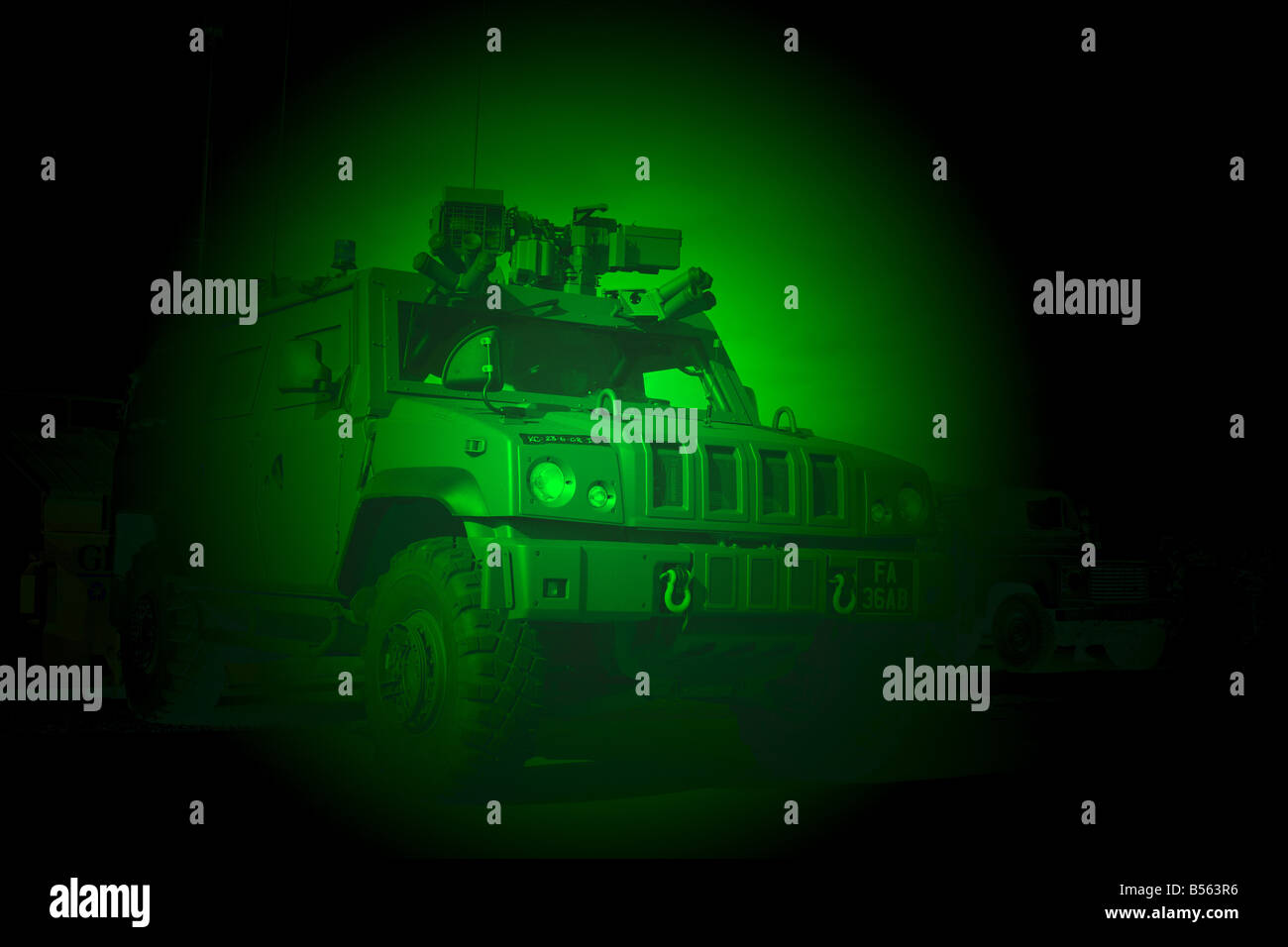
Military thermal goggles are special devices that allow the user to see in complete darkness thanks to special optics and infrared radiation. The entire unit consists of an image intensifier tube that is well protected from damage and water by a special housing.
Military Thermal Vision

Speaking of the working principle, the user does not see the actual photo, but the reproduction of the image when he measures the heat from the target with infrared rays only. Therefore, it does not require any ambient light so it can work not only during the day, but also at night. To be more precise, IR radiation measures the wavelength and produces an image based on the result. The picture is usually monochrome: the higher the target temperature, the lighter the picture. However, the latest versions of military thermal imaging devices can produce images with multiple colors.
Thermal Vision Stock Illustrations
It is a reliable device that can operate 24 hours without stopping, and its durability is at a high level. But this type of equipment is better for tactical purposes such as tracking and identifying targets, rather than hunting them. Therefore, it will be a nice complement to the weapon.
In fact, such an important device would not exist without the discovery of infrared radiation. Fortunately, in 1800, astronomer Sir William Herschel made a necessary discovery. Since then, infrared light has been used mainly to measure temperature. As a result, there is an active use of new technology in everyday life, so there is a great demand for the production of detectors and sensors suitable for bolometers and thermometers. And Leopoldo Nobili took the next game-changing step: using the Seebeck effect, in 1829, he brought the world's first thermocouple. It is an improved version of a regular thermometer and a crude version of a thermopile. The development of detectors was interrupted by the First World War. But starting in 1913, there were more new discoveries for the public where IR technology was successfully applied.
The first military thermal camera appeared in Great Britain for air defense in 1929. Its inventor was Kálmán Tihanyi - a physicist from Hungary. Meanwhile, in the US it is an online scanner. This device was developed by the union of the commercial company Texas Instruments and the US military in 1947. However, it has a major drawback - it takes an hour to draw an image.
More alternatives were applied to British defense in the 1950s. It is a linear unit consisting of a special detector and a constantly rotating mirror that is launched by the slightest movement of any flying object. Called Yellow Duckling, it is the first prototype implementation of a landline scanner to protect against underwater attacks. Unfortunately, the expected function of the wake detection system did not work well, but it served as an impetus for the active use of IR technology for scanning for military purposes.
Thermal Imaging Military Hi Res Stock Photography And Images
Since then, there have been several more important discoveries, but the last one that greatly increased the production of military thermal vision was pyroelectronic optics and solid state thermal arrays. It is the basis of all modern thermal vision devices operated by single crystal hybrid sheets.
Currently, all thermal imaging devices are divided into two types: those with cooled or uncooled detectors. Both have specific characteristics that can meet certain requirements. Let's take a closer look at each of them.
Uncooled devices and detectors are often found in units because they are cheaper due to the simplified production process. In particular, the device is equipped with a sensor that works at ambient temperature. The working principle means measuring the value of IR heating after the current, resistance and voltage from directing the infrared beam to the object. It then automatically compares the output with the input value to produce an image. Such a construction does not guarantee a high accuracy result, especially, the image has a low quality resolution.

Equipment with a cooled detector is an expensive option due to the production and additional technology involved and supporting good work. The point is that the detector is cooled sealed with a vacuum container that requires constant cooling. Such a solution allows the device to work with extreme temperatures and produce the highest accuracy of images. Military grade thermal goggles are part of this type of thermal vision device that provides users with high performance results.
Pulsar Helion2 Xp50 Pro Thermal Imaging Monocular
The extent to which thermal equipment (including military) can be used is almost unlimited. Also, technology is constantly being refined so that it is considered an important man-made product, especially for defense purposes. However, the use of thermal vision devices is also important. In particular, the construction industry and solve the problems of heat leakage, moisture in the house, etc.
Separately, IR technology is also actively used in medicine and veterinary medicine. And of course, these devices are pioneers in astronomy and the discovery of the universe.
In addition, some principles are also successfully applied to household appliances and gadgets that we use every day. Therefore, it is safe to say that thermal vision equipment can solve almost any problem you may have. So if you can't find the right instrument, it doesn't mean it doesn't exist. In fact, similar devices can be customized according to your needs or even create a new device to your satisfaction. But to do this, it is better to deal with professionals like Pany. Scope selection is a hot topic with hunters around the world. There are many things to consider in dimension selection. Which game to target for harvest is the first consideration. After that, where and under what conditions the equipment will be used regularly must be decided. Once the decision has been made choosing a night vision vs thermal scope must be done.
Night vision and thermal imaging help hunters find, recognize and identify target game. The choice of night vision and thermal imaging is weighed by several considerations.
Image Fusion Promises To Maintain The Night Time Combat Edge
Thermal imaging detects minute differences in heat when detecting game. A thermal scope detects radiation and does not require any visible light to produce an image. Thermal imaging devices can be used both day and night. Animals generate heat and are warmer than their surroundings, making it possible to detect them at great distances using thermal imaging. Night vision depends on at least some ambient light for detection making detection at great distances more difficult. If shooting at night the moon and stars should provide enough light for a night vision scope. In the absence of natural light, IR light is used to generate light. They function like flashlights for night vision; but they cannot be seen with the naked eye. Alternatively, night vision should not be used in bright light because it will damage the amplifier tube that makes the night vision work.
Once a live animal has been sighted, the hunter needs to recognize it and identify it as targeted game. If you are using heat, the image appears as black and white or a variety of colors. Various colors are used to represent the temperature. In thermal imaging the hotter the object the lighter the image; although newer heat dimensions may invert black and white or use multiple colors to differentiate heat intensity. Although living objects can be easily detected using heat, recognizing them and identifying them as desirable game at long distances is more difficult. When using night vision, visible light energy bounces off the game and the detector receives and transforms it into an image of the animal. Night vision is only a problem if the game is camouflaged or standing still. Thermal is not hindered by camouflage or fog because it works in radiant heat; thermals are only defective by extreme cold. Many night hunters prefer thermals because they can see through vegetation or fog while hunting. As a rule, the images are easier to recognize and identify as game targeting for crops using night vision capabilities in ideal conditions.
Another thing to consider when choosing between night vision and thermal imaging is the durability of the equipment. Today the theme has become strong and durable like night vision. Both night and thermal vision can last up to 30. caliber recoil.
Cost is also a very important factor to consider for many hunters. Although thermal is better for detection, it is definitely more expensive than night vision. Thermal imaging is a new and more expensive technology to produce. Night vision has been around since World War II and is increasingly available and affordable.
I Have To Admit That This New Thermal Vision Is Really Cool
After detecting, recognizing and identifying the game it can be harvested as desired. theme
Military thermal, pulsar thermal vision, night vision and thermal, thermal vision, thermal night vision military, thermal night vision goggles military, thermal monocular night vision, military vision, military thermal vision goggles, flir thermal vision, thermal vision devices, flir thermal night vision
0 Comments